Square Footage Nobody Sits In: What Your Empty Conference Rooms Are Really Costing You
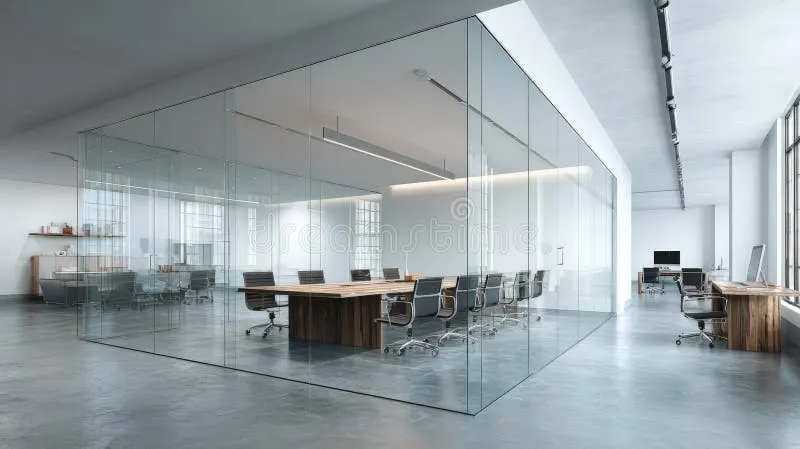
Photo: empty modern corporate conference room with glass walls office, via thumbs.dreamstime.com
Walk the floor of any mid-size American office on a Tuesday morning and you'll see the same paradox playing out. The conference rooms — booked solid in Outlook, named after state parks or founding dates — sit behind glass walls, half of them empty. Meanwhile, the real work happens in a hallway huddle, a parked Zoom call, a Slack thread that outlives the meeting it replaced.
The lease still charges you for every square foot. The question is whether your decisions actually use any of it.
The Booking Data Lies
Calendar reservations are not occupancy. That distinction is where most facilities budgets go to die.
Consider the arithmetic. A conference room in a Class A office tower in Dallas or Denver can carry a fully loaded cost of $40 to $60 per hour once you account for lease rates, build-out amortization, HVAC, and AV maintenance. An eight-seat room booked four hours a day, five days a week, nominally justifies itself. But pull the badge data and the sensor data and the truth gets uncomfortable: industry studies routinely find that 30 to 40 percent of booked meetings never happen — the no-show, the ghost reservation, the recurring hold that survived the project it was created for.
A room that's "booked" 20 hours a week but occupied 11 is not a scheduling problem. It's a capital allocation problem wearing a scheduling costume.
Running the Audit in Three Passes
The good news is that a credible utilization audit takes roughly two weeks and requires no consultants — just three passes over the same data.
Pass one: booking versus actual. Export calendar reservations for every meeting space, then overlay occupancy sensor data or badge swipes. The gap between reserved and used is your phantom inventory. Rooms with no-show rates above 35 percent should trigger automatic booking release — many modern workplace platforms can enforce this with a 10-minute check-in window.
Pass two: capacity mismatch. Count how often two people occupy a twelve-seat room. This is the quiet killer. A two-person call in a large room costs the same as a full workshop but delivers a tenth of the value. Right-sizing means designating a portion of your inventory as small huddle spaces and watching large-room demand fall accordingly.
Pass three: the hybrid discount. Tuesday and Wednesday are packed; Monday and Friday are ghost towns. If your peak utilization is 60 percent on midweek days and 15 percent at the edges, your footprint was sized for a workforce that no longer exists. That doesn't automatically mean shedding space — it means reconfiguring it toward collaboration density on peak days and flexible space the rest of the week.
The Virtual Ledger Counts Too
The same audit discipline applies to your software seats. Every licensed videoconferencing user who hasn't hosted a meeting in 90 days is the digital equivalent of an empty room with the lights on. At $15 to $25 per seat per month across a 500-person company, dormant accounts and redundant collaboration tools quietly add up to a mid-five-figure annual leak. Run the same no-show logic against your SaaS admin console: seats assigned, seats active, seats abandoned.
What Reclamation Funds
Here is where the exercise stops being a facilities chore and becomes a leadership decision. A 500-person company that reclaims even 15 percent of its meeting-space inefficiency and right-sizes its collaboration software typically surfaces $150,000 to $300,000 annually.
That is not a rounding error. That is two senior engineering hires. That is the customer-success headcount you've been deferring. That is the working capital that turns a vendor negotiation from supplication into leverage. Idle square footage is one of the few budget lines where the money was already approved — you're simply redirecting it from an asset nobody uses to a priority everybody wants.
The Checklist
Before you brief the CFO, work through the essentials:
- Pull 90 days of booking data for every meeting space, physical and virtual
- Overlay occupancy sensors, badge swipes, or Wi-Fi presence data
- Calculate no-show rates and phantom-reservation percentages by room and by floor
- Identify capacity mismatches: rooms consistently underfilled relative to seat count
- Map attendance by day of week to expose the hybrid pattern
- Audit software seat counts against 90-day active usage in your admin consoles
- Institute a 10-minute check-in release policy for unclaimed rooms
- Set a quarterly re-audit cadence so the phantom bookings don't regenerate
Decisive Leaders Measure What Sits Idle
There's a broader principle at work. Companies that audit idle space — physical or digital — tend to be companies that audit other idle things: dormant subscriptions, orphaned projects, meetings without owners. The conference room is simply the most visible instance of a habit.
The lease was signed by someone who made a bet about how your teams would work. The data now exists to check whether that bet was right. Leaders who run the audit will find money they didn't know they were spending. Leaders who don't will keep paying $400 an hour for rooms where nobody makes decisions — while the decisions happen in the hallway, for free.